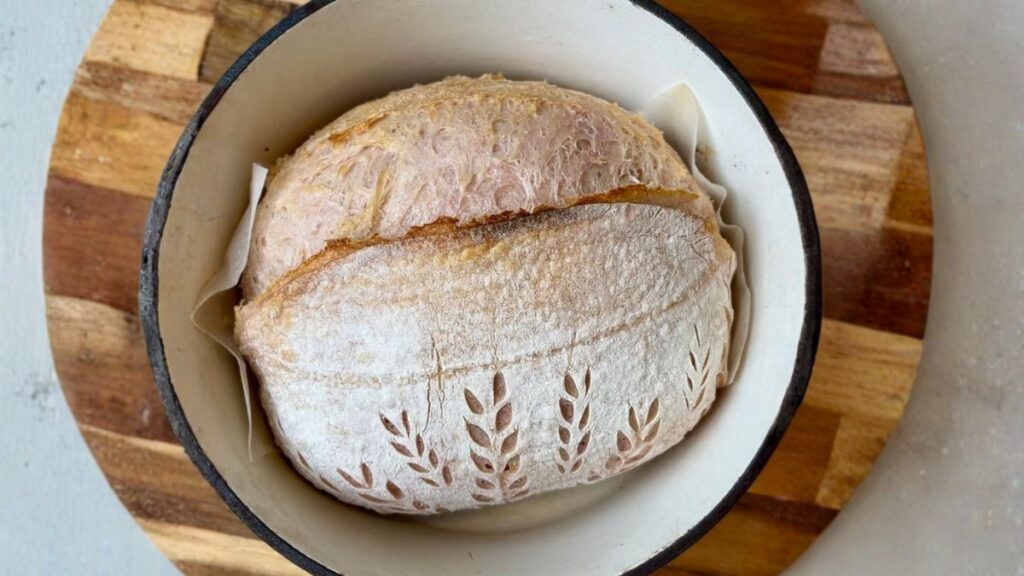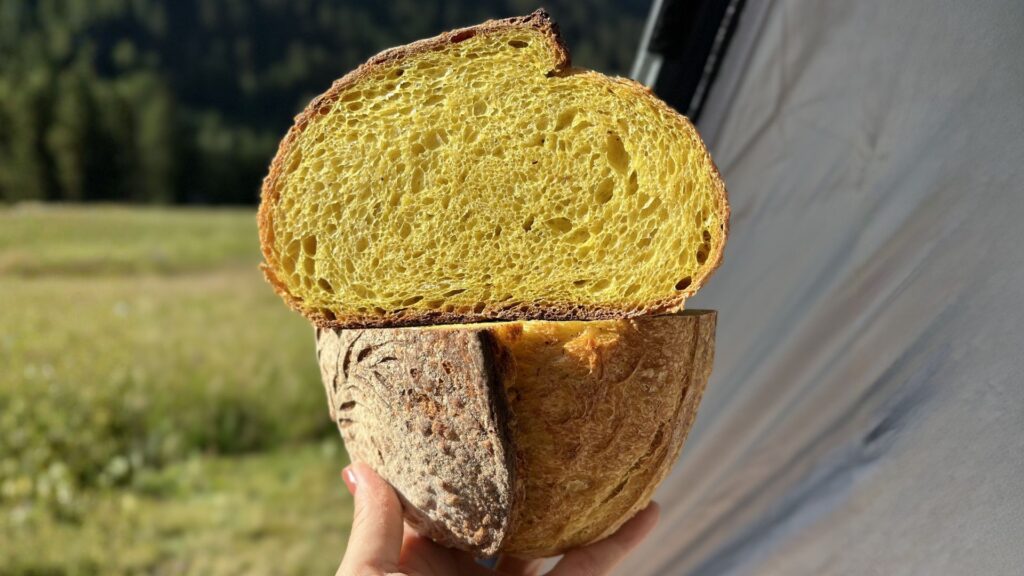
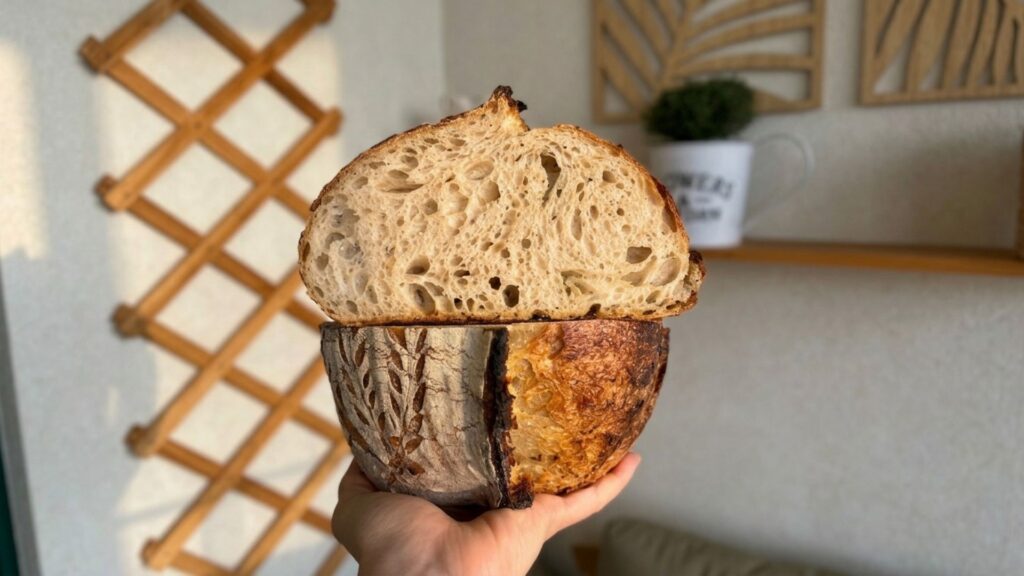
People ask me for my "best" sourdough recipe a lot, and it's not the flashy purple loaf or the one with tomato and herbs folded through it. It's this one. Four ingredients, nothing added, nothing to fuss over. I've made it so many times I could probably shape it with my eyes closed, and it's the loaf I still reach for when I want to know a bag of flour or a batch of starter is behaving the way it should.
If you're new to sourdough, start here. If you've been baking a while, this is worth keeping in your back pocket too, it's the baseline everything else gets compared against.
The Dough
Ingredients
- 400g bread flour
- 280g water (70% hydration)
- 80g active starter (100% hydration)
- 9g salt
That's it. No seeds, no mix-ins, no flavor powders. When a recipe is this short, every ingredient is doing real work, and it also means there's nowhere for a lazy starter or tired flour to hide. If this loaf comes out flat or dense, that's useful information about your process, not bad luck.
Mixing and Autolyse
Start with just the flour and water. Mix them together until there's no dry flour left, then leave it alone for an hour. This is the autolyse, and its whole job is to let the flour fully hydrate and the gluten start organizing itself before you ask it to do anything else.
After the hour is up, add the starter and mix it in, then add the salt and work it through by hand until it's fully incorporated. The dough will feel a bit shaggy and uneven at this point. That's normal, it smooths out during bulk.
💡 A note on starter timing
Use your starter when it's active and near its peak, risen and domed, not yet collapsing. A sluggish starter is one of the most common reasons a first loaf comes out dense, and it has nothing to do with your technique.
Bulk Fermentation
This is where the dough actually becomes bread. Give it two sets of stretch-and-folds, then two sets of coil folds, spaced about 30 minutes apart. After that, leave it be and let it keep fermenting.
You're watching for the dough to look well aerated and to have grown by about 30 to 50 percent, not doubled, just noticeably puffier and a little jiggly when you nudge the bowl. Depending on how warm your kitchen is, this whole stretch usually lands somewhere around 4 hours, but let the dough tell you when it's ready rather than watching the clock too closely.
🌡️ Temperature changes everything
A warm kitchen will get you there faster, a cool one will take longer. Neither is wrong, it's just a different timeline to the same result.
Shaping and Cold Proof
Once bulk is done, shape the dough into a tight round or batard, whichever you're more comfortable with, this loaf doesn't ask for anything specific here. Place it in your banneton and pop it in the fridge to cold proof overnight.
The cold proof isn't just about convenience, it's where a lot of the flavor develops and the crumb structure sets. Don't skip it if you can help it.
Baking
Method
- Autolyse. Mix 400g bread flour and 280g water until no dry flour remains. Rest 1 hour.
- Add starter and salt. Mix in 80g active starter, then add 9g salt. Work by hand until fully incorporated.
- Bulk ferment. Give the dough 2 sets of stretch-and-folds, then 2 sets of coil folds, 30 minutes apart.
- Let it finish. Continue bulk fermentation until the dough is well aerated and risen 30–50%, roughly 4 hours depending on your kitchen.
- Shape. Shape into a round or batard and place seam-side up in a floured banneton.
- Cold proof. Cover and refrigerate overnight.
- Bake. Straight from the fridge, bake at 250°C for 25 minutes with steam, then 230°C for 20–25 minutes without steam, until deeply golden.
Plain Sourdough Loaf
Ingredients
- 400 g bread flour
- 280 g water
- 80 g active sourdough starter
- 9 g salt
Instructions
- Mix the bread flour and water together until no dry flour remains. Rest 1 hour (autolyse).
- Add the starter and mix in, then add the salt and work by hand until fully incorporated.
- Bulk ferment: do 2 sets of stretch-and-folds, then 2 sets of coil folds, 30 minutes apart.
- Continue bulk fermentation until the dough is well aerated and risen 30-50%, about 4 hours depending on kitchen temperature.
- Shape into a round or batard and place seam-side up in a floured banneton.
- Cover and refrigerate overnight to cold proof.
- Bake at 250°C for 25 minutes with steam, then 230°C for 20-25 minutes without steam, until deeply golden.
- Cool completely before slicing.
Let it cool completely before slicing, I know that's the hardest part. Cutting into a hot loaf lets the steam escape too fast and you'll end up with a gummier crumb than the bake actually gives you.
How I Actually Eat It
Warm sourdough with honey and a bit of sea salt will forever be one of my favorite combos, and it's exactly what I reach for with this loaf more often than anything fancier. Simple bread deserves a simple ending.
This is one way to make a plain sourdough loaf, not the only way, but it's the one I trust when I want to know my starter and my process are both doing their job. Try it, and tell me how your crumb turns out.
↑ Back to topOnce you've got this one down, you've basically got the blueprint for every loaf on this site.
See More Bread Recipes